
Dauphin County Dissolution Of Marriage Records
Dauphin County dissolution of marriage records are maintained by the Prothonotary at the Dauphin County Courthouse in Harrisburg, Pennsylvania. As the home of Pennsylvania's state capital, Dauphin County is uniquely positioned near state-level vital records offices and judicial administrative agencies. The county has maintained civil court records including all divorce filings since its establishment in 1785. Anyone who needs to search for a past dissolution of marriage, obtain a certified copy of a decree, or understand the filing process in Harrisburg can use the resources and guidance provided throughout this page.
Dauphin County Quick Facts
Dauphin County Prothonotary Office
The Dauphin County Prothonotary is the official custodian of all civil court records in the county, including every dissolution of marriage case filed since 1785. The Prothonotary receives and indexes all civil filings, assigns docket numbers, and maintains the complete case file from first complaint through final decree. The office is led by an elected official who serves a four-year term and holds authority to sign and seal court documents, enter judgments, administer oaths, take bail in civil actions, and maintain custody of all civil court records.
Harrisburg, the county seat, is the capital of Pennsylvania. The Pennsylvania State Capitol building stands in Harrisburg, and most major state agencies, including the Department of Health, maintain offices in or near the city. This proximity to state government gives Dauphin County residents convenient access to the Pennsylvania Division of Vital Records and other agencies that issue official dissolution of marriage documentation.
The Dauphin County Court of Common Pleas handles all dissolution of marriage proceedings for a county of nearly 285,000 residents. The court operates under the statewide unified judicial system and uses the same case management tools as every other Pennsylvania county court.
| Court | Court of Common Pleas - Dauphin County |
|---|---|
| Address | 101 Market Street, Harrisburg, PA 17101 |
| Phone | (717) 780-6500 |
| Hours | Monday through Friday, 8:30 AM to 4:30 PM |
| Website | dauphincounty.org/Prothonotary |
Note: The filing fee for dissolution of marriage in Dauphin County is $297.00. This applies to a standard divorce complaint; additional fees may apply for motions and other filings over the course of the case.
How to Search Dauphin County Divorce Records
The Unified Judicial System Web Portal is the primary free tool for searching Dauphin County dissolution of marriage records. The portal covers all Pennsylvania county courts and allows searches by party name or docket number. Results include case status, docket entries, and lists of filed documents. No account is needed, and most active and recent cases are available online. The Jenkins Law Library UJS search guide provides detailed tips for getting the most out of the portal, including advanced filtering and how to interpret docket entries.
For older cases not yet in the electronic system, usually those filed before the mid-1990s, the Dauphin County Prothonotary maintains physical index books and paper case files. Visiting in person during business hours is the most efficient way to search older records. Bring the names of both parties and the approximate year of filing to help staff locate the file. Written requests by mail are accepted but may take additional processing time.
The CountyOffice.org Pennsylvania divorce records directory provides a statewide overview. The FamilySearch Pennsylvania Divorce Records wiki is helpful for genealogical research involving older Dauphin County dissolution filings. For online ordering of state-issued certificates, VitalChek is the authorized state partner.
Dauphin County Court Records Image
The Pennsylvania Courts website for Dauphin County provides information on the court's caseload, judge assignments, and how to access dissolution of marriage records through the statewide portal.
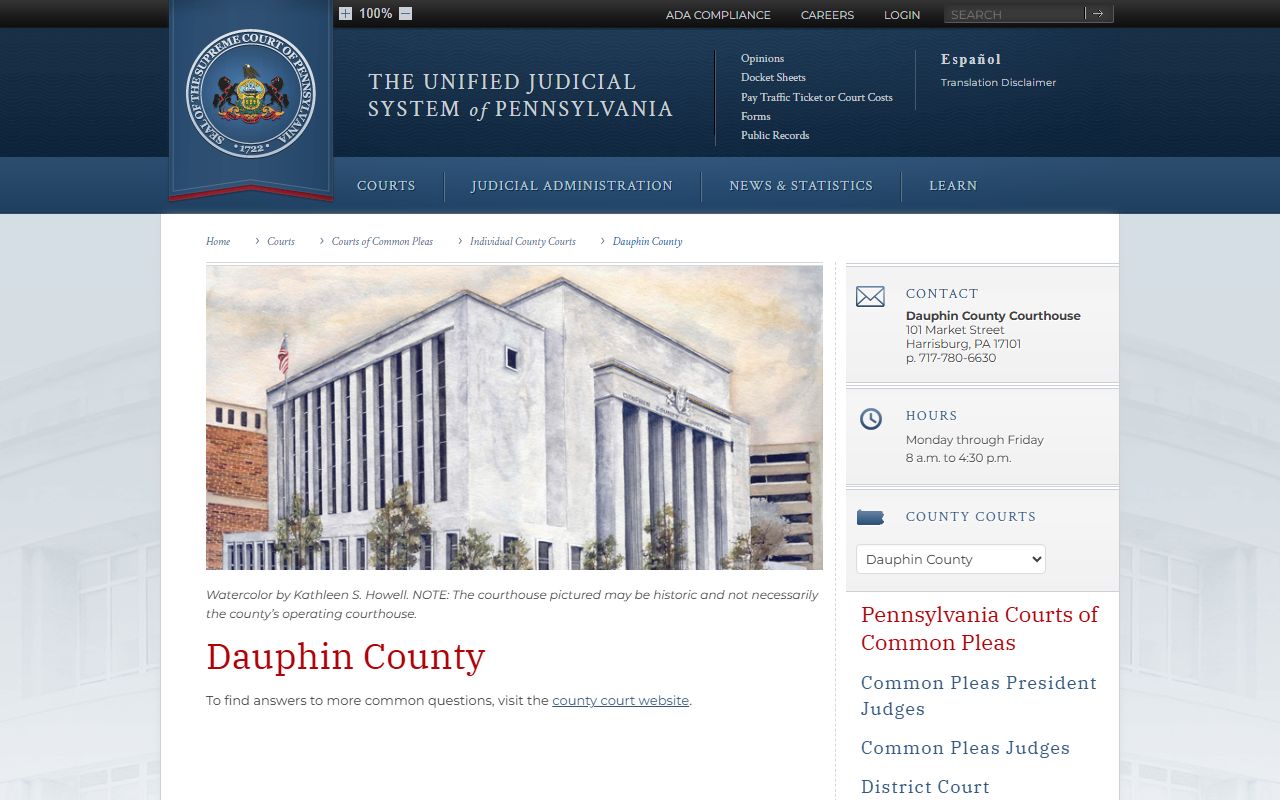
The Dauphin County Court of Common Pleas in Harrisburg processes all dissolution of marriage cases for Pennsylvania's capital county, with a current filing fee of $297.00.
The Pennsylvania Department of Health Division of Vital Records is accessible to Dauphin County residents, with state offices nearby in the Harrisburg area.
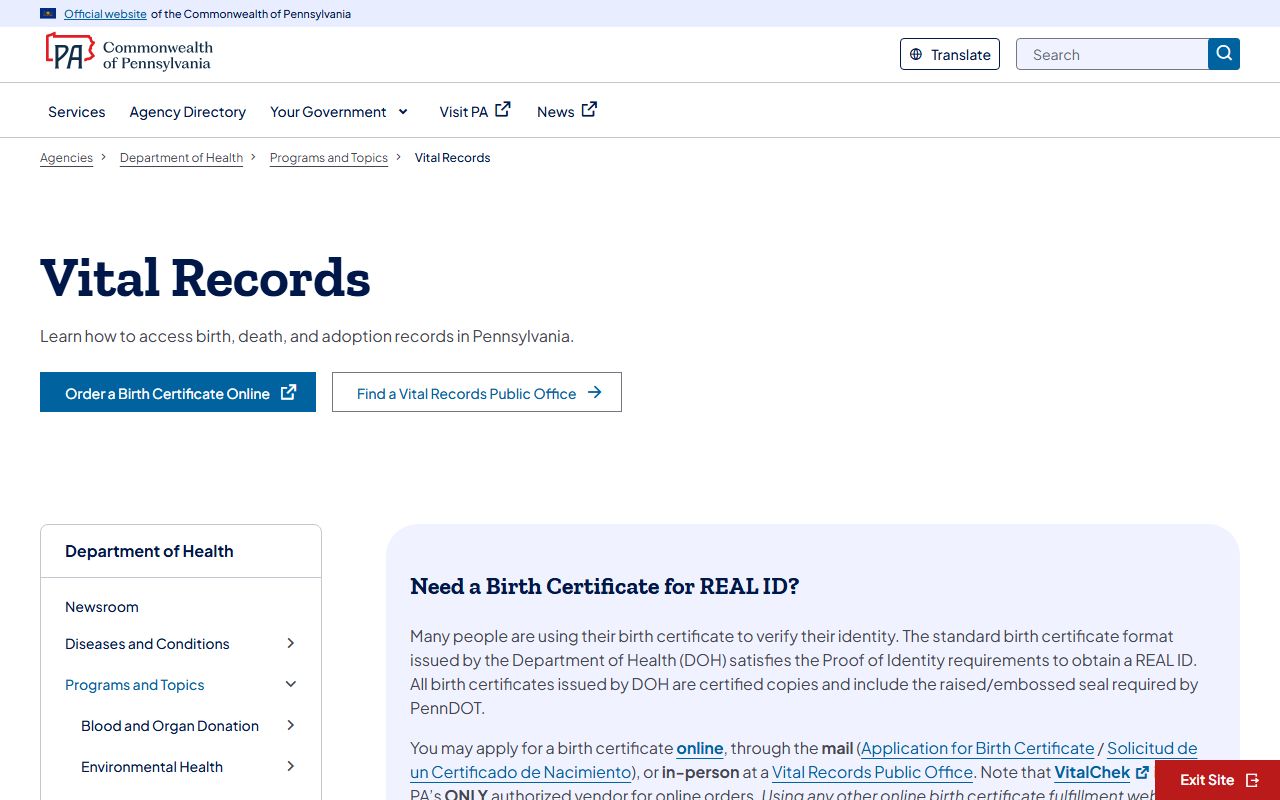
The Pennsylvania Division of Vital Records issues state-level divorce certificates for $20 per certified copy, confirming dissolution of marriage for cases filed throughout the state including Dauphin County.
Filing for Dissolution of Marriage in Dauphin County
To file for dissolution of marriage in Dauphin County, at least one spouse must have been a Pennsylvania resident for six months before filing, as required by 23 Pa.C.S. § 3104. The complaint in divorce is filed at the Prothonotary's Office at 101 Market Street in Harrisburg. The current filing fee is $297.00. After filing, the plaintiff must serve the complaint on the other party before the case can proceed.
No-fault dissolution under 23 Pa.C.S. § 3301 is the most common route in Dauphin County. Mutual consent allows both parties to end the marriage after a 90-day waiting period from the date the complaint is served. Irretrievable breakdown allows one party to obtain a divorce after a one-year separation, provided the separation began on or after December 5, 2016. Both no-fault paths require that both parties sign affidavits confirming consent or the separation, respectively. Fault grounds remain available and include abandonment without cause for one year, adultery, cruel and barbarous treatment, and bigamy.
The definitions used in dissolution proceedings, including what counts as marital property and what constitutes a marriage, are set out in 23 Pa.C.S. § 3103. Pennsylvania uses equitable distribution to divide marital assets under 23 Pa.C.S. § 3502. A Dauphin County judge weighs the length of the marriage, each party's income and economic circumstances, contributions to the household, and any dissipation of assets before entering a property division order. The division must be fair; it is not required to be equal.
Certified Copies and Vital Records for Dauphin County
Certified copies of Dauphin County dissolution of marriage decrees are available from the Dauphin County Prothonotary. These copies carry the court's official seal and are accepted by courts, government agencies, and financial institutions as proof of a dissolved marriage. They include the complaint, service documents, all orders, and the final decree. Fees vary; contact the Prothonotary before submitting a request to confirm current pricing.
The Pennsylvania Department of Health Division of Vital Records issues state-level divorce certificates for $20 per certified copy. Because the state's vital records offices are based in New Castle and not in Harrisburg, Dauphin County residents should contact that office directly at PO Box 1528, New Castle, PA 16103-1528, phone (724) 656-3100. Online ordering is available through VitalChek. State certificates confirm the dissolution but do not include the full case file held by the county Prothonotary.
For Dauphin County residents who need legal help with a dissolution case, PA Legal Aid offers free assistance to qualifying individuals. Given the county's role as the state capital, residents also have easy access to the North Penn Legal Services network and other legal aid resources in the broader region.
Public Access to Dauphin County Dissolution Records
Dauphin County dissolution of marriage records are public documents under Pennsylvania's Right-to-Know Law, 65 P.S. § 67.101. The Prothonotary must provide civil case records to any person who requests them. Sealed portions of a case, such as those involving minor children or court-ordered confidentiality, require a legal basis to access. Most dissolution case files are fully open to the public. Free docket viewing for active and recent cases is available through the UJS Portal without visiting the Harrisburg courthouse.
Nearby Counties
Dauphin County sits in south-central Pennsylvania and is surrounded by several counties that each maintain their own dissolution of marriage records through separate Prothonotary offices.