
Reading Pennsylvania Dissolution Of Marriage Records
Reading is the county seat of Berks County and one of the larger cities in Pennsylvania with around 95,000 residents. Because Reading sits at the heart of the county, residents have direct access to the Berks County Courthouse for all Dissolution Of Marriage filings and record searches. Whether you need to look up a case, get a certified copy of a decree, or start the process yourself, this guide explains what to expect and where to go in Reading and Berks County.
Reading Quick Facts
Where to File Dissolution Of Marriage in Reading
Reading residents file for Dissolution Of Marriage at the Berks County Court of Common Pleas. The Prothonotary's Office handles all civil filings, including divorce. Since Reading is the county seat, the courthouse is located right in the city. The Berks County Prothonotary is the office that accepts new filings, maintains the case index, and provides copies of court documents.
The Berks County Prothonotary's Office is located at 633 Court Street, 2nd Floor, Reading, PA 19601. Phone: 610-478-6970. Hours are Monday through Friday, 8:00 AM to 5:00 PM. The office processes both walk-in requests and written requests submitted by mail.
It is strongly recommended that you hire a lawyer when filing for dissolution of marriage. For help finding one, call the Berks County Bar Association Lawyer Referral Service at 610-375-4591. The Berks County Self Help page also provides forms and guidance for those who choose to represent themselves.
| Court | Berks County Court of Common Pleas, Prothonotary's Office |
|---|---|
| Address | 633 Court Street, 2nd Floor, Reading, PA 19601 |
| Phone | 610-478-6970 |
| Hours | Monday through Friday, 8:30 AM to 4:30 PM |
| Website | Berks County Divorce Records |
Note: Pennsylvania requires six months of residency before a person may file for dissolution of marriage. This rule is set out in 23 Pa.C.S. § 3103. Once the residency requirement is met, Reading residents file in Berks County.
Accessing Berks County Dissolution Records
The Berks County divorce records system gives the public several ways to search and obtain case information. Records are kept in the Prothonotary's office and are public under Pennsylvania's Right-to-Know Law at 65 P.S. § 67.101, with limited exceptions for sealed documents.
To search or request records, you will need the full names of both parties, an approximate filing date or year, and the case number if you have it. If visiting in person, bring a valid government-issued photo ID. Written requests by mail should include all of that information along with payment for copy fees.
The statewide Pennsylvania Unified Judicial System portal also covers Berks County cases and is available online at no charge. This is useful for finding a docket number before visiting the courthouse or for confirming basic case details.
The Pennsylvania Courts Berks County page provides current contact information and links to local court resources.
The Berks County divorce records page maintained by the county outlines what documents are available and how to access them.
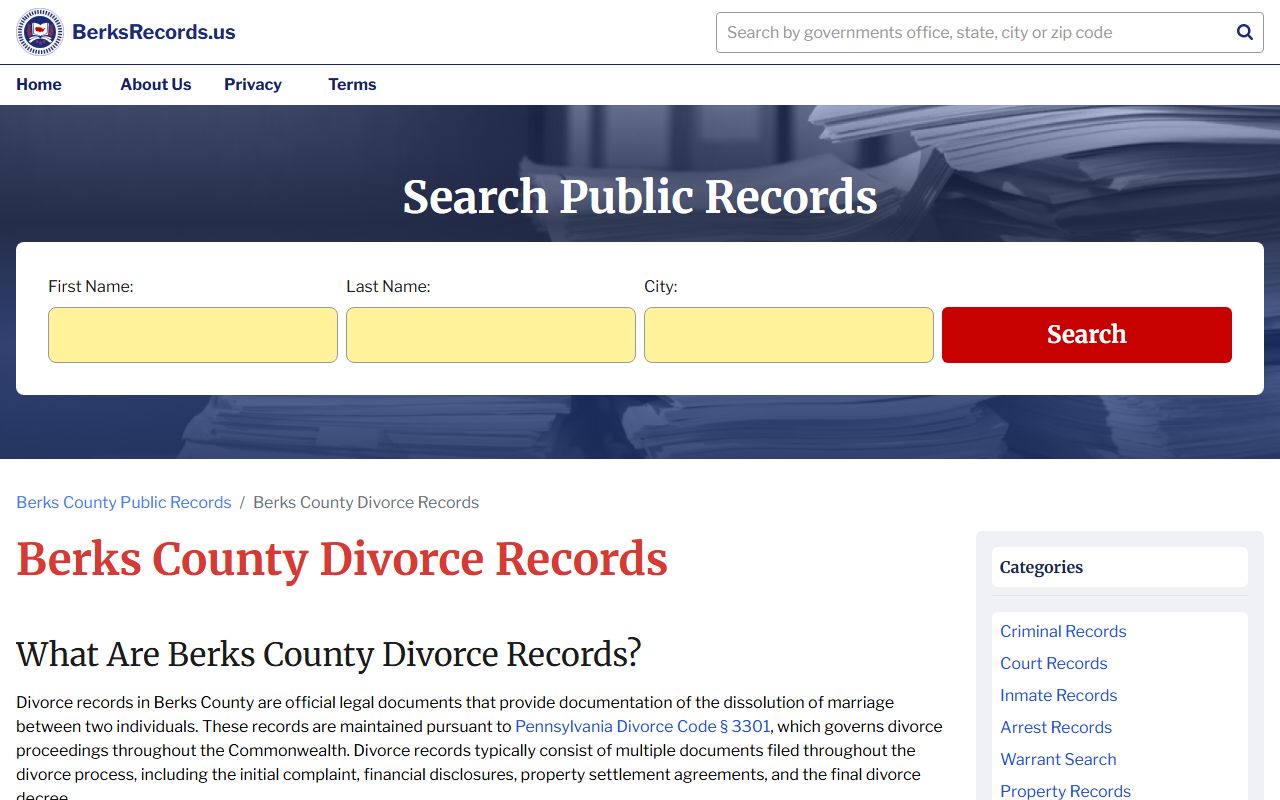
Berks County has maintained dissolution of marriage records since 1804 in the Prothonotary's office, giving Reading residents access to a long and complete court record history.
Pennsylvania Dissolution Of Marriage Grounds and Process
Reading residents filing for divorce must choose between fault and no-fault grounds. Pennsylvania's divorce statute is found at 23 Pa.C.S. § 3301. No-fault divorce is the most common path and comes in two forms.
Mutual consent divorce requires both spouses to sign affidavits agreeing to the dissolution. After a 90-day waiting period from the date the complaint is served, the court can grant the divorce. Both parties must also resolve any financial or custody issues before the decree is entered, or the court will handle those matters separately.
If one spouse does not consent, the other may still file under the separation ground. Since December 5, 2016, the required separation period is one year. Before that date, the required period was two years. Evidence of separation may include separate residences, separate finances, and other indicators that the parties have stopped living as a married couple.
Fault grounds remain available under Pennsylvania law. These include willful desertion for one year, adultery, cruel and barbarous treatment, bigamy, imprisonment for two or more years, and indignities. Fault cases require more evidence and are more complex. Most Reading residents choose no-fault unless there is a specific reason to pursue fault grounds.
Note: The Berks County Divorce Self Help center provides forms and step-by-step instructions for people who choose to handle their own dissolution case without an attorney.
Property Division and the Dissolution Decree
Pennsylvania is an equitable distribution state. When marital property is disputed, the court divides it based on what is fair using the factors in 23 Pa.C.S. § 3502. Those factors include each spouse's age, health, length of the marriage, economic circumstances, and their contributions to the household. Courts do not split property down the middle; they weigh these factors and decide what is equitable.
Many Reading couples reach a property settlement agreement on their own before going to court. That agreement can be filed with the court and made part of the final decree. Once the court signs the decree, it is enforceable. Certified copies of the decree can be obtained from the Prothonotary's office for a fee.
The dissolution decree is an important document. It may be needed to enforce spousal support orders, finalize custody arrangements, divide retirement accounts, and transfer real estate. Keep at least one certified copy in a safe place after the case is closed.
For state-level certificates, the Pennsylvania Department of Health Vital Records issues certified divorce certificates for $20 each. These are different from court copies and are often used for purposes like name changes or benefits claims. You may also order online through VitalChek.
The Pennsylvania Legal Aid Network offers free assistance to qualifying residents who need help understanding property division, custody, or support during a dissolution case. Legal aid offices can help with forms, explain the process, and in some cases provide direct legal representation.
The Pennsylvania Department of Health manages state vital records including certified divorce certificates.
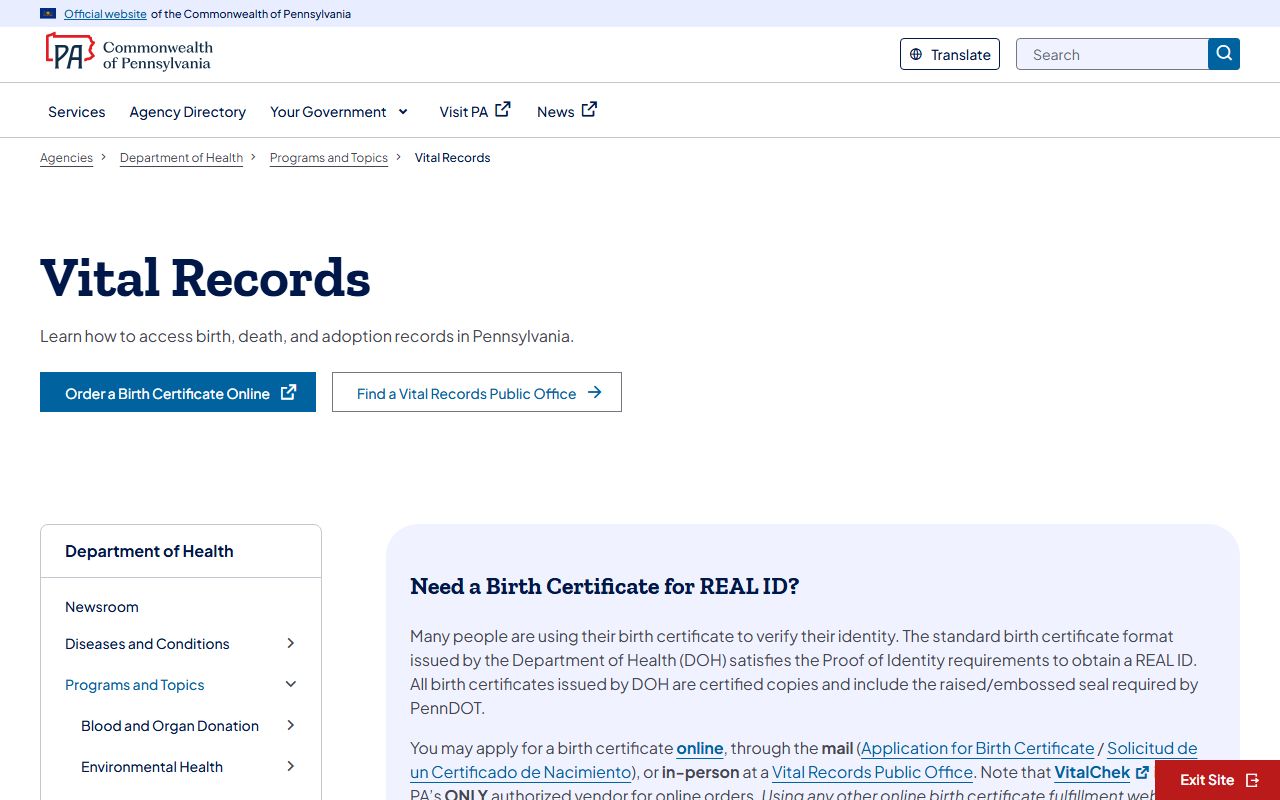
State divorce certificates from the Department of Health are separate from court-issued copies but serve an equally important role for legal and administrative purposes.
Reading County Divorce Records
Reading residents file all Dissolution Of Marriage cases at the Berks County Courthouse on Court Street in Reading, where the Prothonotary's Office maintains the complete index of divorce cases and provides certified copies to the public.
Nearby Pennsylvania Cities
Each nearby city's dissolution of marriage cases are filed at the county courthouse serving that city. Search records by city to find the right filing location.